
Comparing Two Custom Perfume Factories for an Influencer Launch
Two custom perfume factories rarely differ in the way a quotation suggests. They differ in how they make decisions when something unexpected appears: a material is short, a note reads differently at volume, a drop date moves. For an influencer launch, where the announcement is tied to content, pre-orders and audience expectation, that decision pattern is what you are really choosing between. This comparison sets out how to read two candidates side by side before either one is briefed.
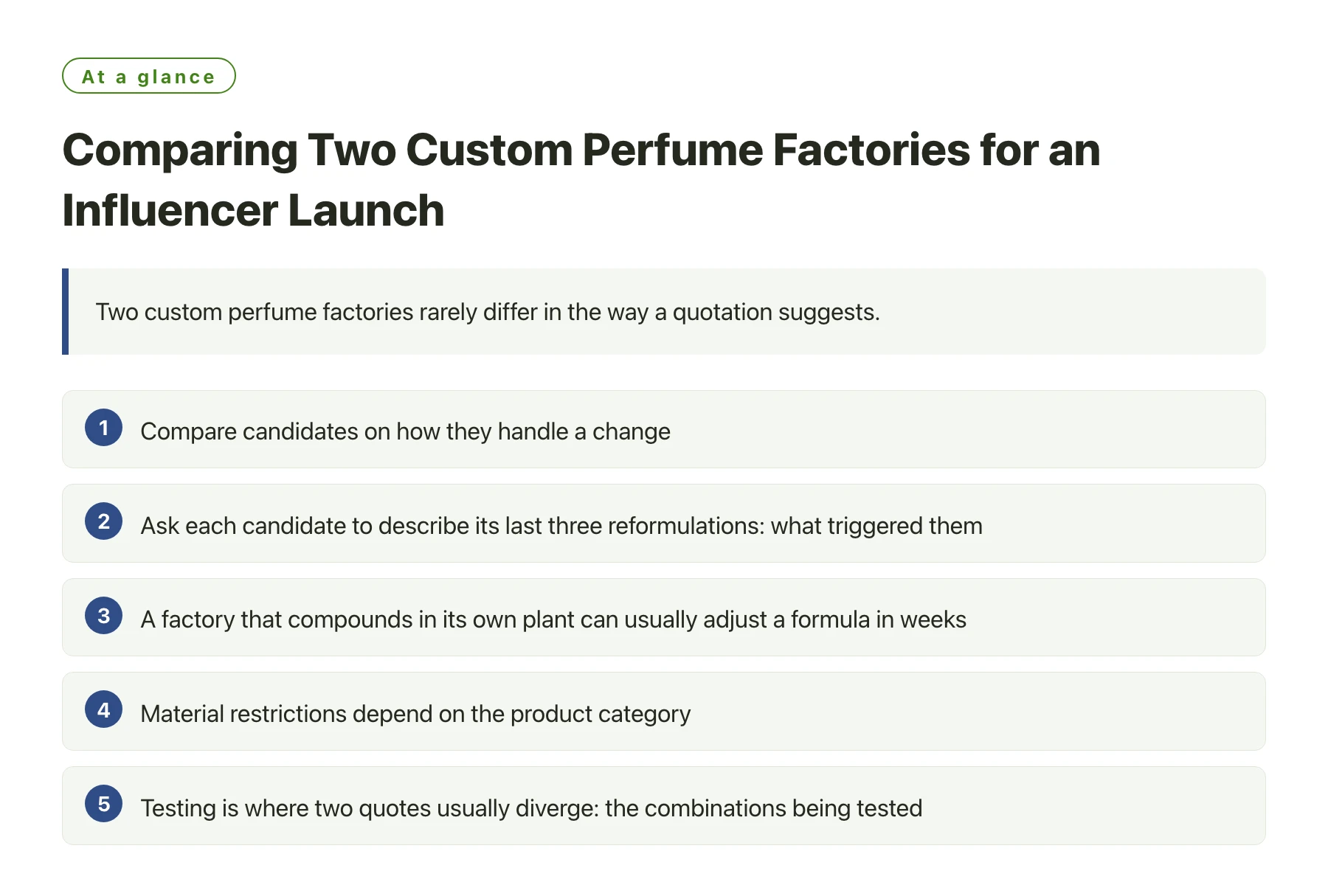
Key takeaways
- Compare candidates on how they handle a change, not on the sample they present, because the sample round is the most controlled moment in the whole project.
- Ask each candidate to describe its last three reformulations: what triggered them, who decided, and what the buyer was told at the time.
- A factory that compounds in its own plant can usually adjust a formula in weeks, while one that brokers production adds a coordination step that tends to surface later as lead time.
- Material restrictions depend on the product category, so both candidates should be able to name which materials in a candidate formula carry limits and how much room is left [1].
- Testing is where two quotes usually diverge: the combinations being tested, the conditions they are held at, and the party that commissions the work should all be named before either quote is compared [2].
A creator preparing a fragrance drop usually starts with two or three factories that were recommended, found through a supplier directory, or met at a trade fair. On paper the two look similar: both offer custom development, both show samples, both quote a unit price at a stated volume. The difference only becomes visible when you ask them to describe a project that went sideways.
The reason the sample round is a poor comparison point is that it is the calmest part of the process. Sampling happens with chosen materials, small batch sizes and a schedule that has not yet collided with anything. Production is where variability lives: a raw material arrives at a different strength, a decanter runs hot, a glass supplier ships late. A factory is essentially the set of routines it uses to notice those things early.
This is a working comparison for an influencer launch, written from the product development side. It uses two common factory profiles, not two named companies, so the pattern can be applied to whichever candidates are actually on the table.
The framing matters because a creator-led launch compresses decisions. The audience is told a date, content is shot around it, and a delay is not just a production problem — it becomes a public one. The comparison below is therefore weighted towards response time and evidence, rather than towards the lowest quoted price.
Two common factory profiles, compared on the points that move a date
| Decision point | Profile A: compounds and fills in its own plant | Profile B: develops and brokers production | Why it matters for a drop date |
|---|---|---|---|
| Where the formula is made | Compounding, filling and packing sit on one site under one quality system | Formula is developed in-house, then placed with partner plants for bulk | A single site means one schedule to negotiate instead of several |
| Response to a material shortage | Substitution is proposed, tested and re-approved internally | The buyer often learns about the shortage from the partner plant, later | Each extra handover adds days that are rarely quoted up front |
| Sample rounds available | Successive in-house rounds at small scale on the production line | Rounds depend on partner scheduling windows | Sampling speed sets when content can be filmed and pre-orders opened |
| Reference retention | Approved reference kept next to the batch record it belongs to | Reference may be split between two parties | Repeat orders are judged against whatever was actually kept |
| Testing ownership | Stability and compatibility work commissioned directly | Testing coordinated across two suppliers | Broken coordination is the most common hidden delay in a first run |
| Change of scope mid-project | Quoted as a written revision against the original specification | Routinely absorbed into a verbal adjustment | Informal changes are what make a schedule impossible to hold |
Neither column is automatically better. Profile B can be the right choice when a brand needs a specialist glass or a format that one plant does not run, and Profile A can be the wrong choice when a small first order needs a catalogue bottle rather than a custom mould. What matters is that the profile is understood before the brief is sent, which is the practical purpose of how to compare perfume factories rather than a comparison of headline prices.
The three questions that separate the two candidates fastest
There is no need to audit two factories to tell them apart. Three questions, asked in the same order to both, usually do it. Trade coverage of the fragrance category is a useful place to watch how quickly creator-led brands now move from first announcement to first sale, and it sets the clock the two candidates will be judged against [3].
First, ask how a change is priced. A creator launch almost always changes once: the volume moves, the bottle changes, or a note is softened after the first test panel. A candidate that answers with a written revision process is showing you that scope has a boundary. A candidate that says it will be handled is showing you that the boundary is informal.
Second, ask who signs the approved reference. This sounds administrative, but it decides what happens at the second order. When a reference is retained by the party that will run bulk production, a reorder can be compared against something physical. When it is retained somewhere else, the comparison becomes a conversation.
Third, ask what is tested and by whom. Compatibility and stability work can be commissioned directly by the manufacturer or coordinated across suppliers, and independent laboratories publish their cosmetics testing scopes openly [2]. The answer tells you how the project will be supervised when it is no longer exciting.
Sampling speed is not the same as sampling rigour
A factory that can turn around a sample in ten days is attractive, and it should be. The question to add is what is being sampled. A quick round produced from a stock concentrate and a catalogue base is a different object from a quick round built from the candidate formula that will actually be produced. Both have a place, but only one of them tells you anything about the bulk order.
It also helps to ask how many rounds are included and what happens when they are used up. Creators often need more rounds than a conventional brand because the audience is part of the test panel. A candidate that treats the fifth round as a costed revision is being honest; a candidate that promises unlimited rounds is describing a scope it has not priced.
What a second quote never includes
Two quotes can be thirty per cent apart and both be accurate, because they are rarely quoting the same thing. One may include bottle decoration and filling; the other may quote fragrance compound only. One may include stability testing; the other may leave it to the buyer.
Before comparing numbers, line the two quotes up against the same scope list and mark every line that only one of them mentions. The gaps are the real comparison. A full-service programme covers compounding, filling and packing under one roof, which is why the scope statement of a factory that handles fragrance R&D and production is usually longer than a competitor's — it is describing more of the project, not a higher margin on the same work.
If the two candidates still look equal after all of this, choose on the calendar. Ask each one, in writing, for the earliest date a production-scale sample can be held in hand and the latest date a change can be accepted without moving the bulk date. Those two answers are the ones a creator launch is actually built on. A partner that works as a custom perfume factory from brief to sealed bottle will usually be able to give both dates in a single reply, because the schedule lives inside one organization.
Sources
- IFRA Standards Library (International Fragrance Association) —— The IFRA Standards Library lists the restrictions the fragrance industry applies to individual fragrance ingredients, based on safety assessments; it is the reference point for compliant fragrance formulation.
- SGS: Cosmetics, Personal Care & Household Testing —— Testing, inspection and certification services for cosmetics and personal care, including microbiological, stability and safety testing aligned with cosmetics GMP.
- Cosmetics Business —— A trade publication covering the beauty and cosmetics industry, including fragrance launches and regulatory developments.
Frequently asked questions
Should an influencer fragrance launch use a factory that also makes other brands' products?
Usually yes, and the useful question is not whether other brands are served but how exclusivity is handled. A factory that produces for many brands will have a standard mechanism for keeping a composition out of another client's range. Ask to see how that is recorded rather than assuming it is impossible.
How many sample rounds should be budgeted for a creator-led launch?
Budget for more than a conventional brand would, because the audience becomes an informal test panel and feedback arrives in public. Three to five rounds is a common working assumption for a first scent, with the cost of additional rounds agreed in advance so that the fifth round does not reopen the whole commercial discussion.
Is a lower minimum order quantity a reason to choose one factory over another?
It can be, but only alongside the format. A low minimum on a standard bottle and a low minimum on a custom mould are not comparable. What matters for a first creator drop is whether the minimum applies to the fragrance, the packaging, or the finished unit, and whether a trial run can be split into stages.
What should be signed before development begins?
At minimum: the scope of development and the number of rounds, the ownership and use rights attached to the formula, the exclusivity position, the price of a reorder, and the delivery date that both parties are planning against. Anything left verbal will be interpreted differently by the two sides six weeks later.
How early should a factory be briefed for a launch tied to a content calendar?
Work backwards from the announcement, not from the filming date. Add the production lead time, the decoration time if the bottle is customised, a testing window, and one buffer for a single revision. A creator launch usually needs the approved sample in hand at least four to six weeks before anything is shot, which means the brief should be settled well before the content plan is finalised.
— Villas Saint-Jean, Villefranche-sur-Mer